


PSA Peugeot/Citroen launches 1.2 litre PureTech petrol 3-cylinder engine
Across the globe the drive is on to create more efficient petrol and diesel engines as range anxiety stalks electric vehicles and plug-in hybrid technology remains an expensive option.
Diesel power has blazed the trail for economical driving for more than two decades but now petrol power is making a comeback with some amazing advances in technology.

Already dealers are beginning to see a swing away from diesel cars in ever expanding urban centres where the extra initial cost of purchase does not make sense for low mileage drivers. Another factor in the re-think is that short city journeys can be harmful to the exhaust management systems in diesel with costly bills looming after three or four years. Add to this the increased efficiency with lower C02 emissions, and consequent lower tax charges of new petrol technology and it is not surprising that petrol is making a comeback.
New technology is putting petrol powered cars back on drivers’ shopping lists and diesel supremacy is under threat on a number of fronts, including economy and driver satisfaction as one of the worlds top engine manufacturers launches its latest breakthrough technology.
The PSA Peugeot/Citroen Group has just launched a new turbocharged version of its direct injection lightweight 1.2 litre PureTech petrol 3-cylinder engine that runs silently, and has diesel rivaling fuel consumption and excellent low speed torque..
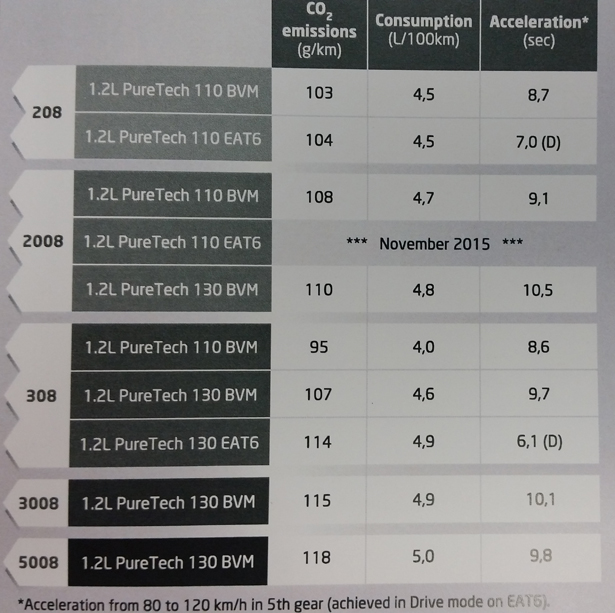
The new engine is on sale in the 308 and 308Sw and will also be used in the 208, 2008 crossover, 3008 and 508 range of cars with power output ranging from 110bhp to 130bhp with C02 emissions ranging between 104g/km and 118g/km with fuel consumption ranging from 4.5L/100km (64mpg) to 5L/100Km (55mpg) in their new flagship model.
The new engine replaces its 1.6 litre 4-cylinder petrol engine and is up to 20 per cent more fuel efficient on average. Peugeot says that in the 208 and 2008 model up to 61.mpg can be expected with 107c/km of C02 emissions without and drawbacks on performance as the new generation turbo unit has the best low rev torque/power compromise with 95 per cent of torque available from 1500rpm to 3500rpm.
Maximum torque is reached at 1650rpm.The continuous power and 230NM of torque available from the lowest engine speeds has been hailed by PSA engineers as a technological revolution because of its exceptional punchy performance and constant power up to 6000 prm while remaining remarkably quiet.
The multi-million euro investment by the French company over four years is a cornerstone of the PSA strategy to get their average vehicle C02 emissions to 95g/km by 2020. A naturally aspirated version of the PureTech unit is already in use and this new engine comes hard on the heels to PSA’s BlueHDi 1.6 litre 75bhp which has a claimed 3L/100km (94mpg) fuel consumption figure.
A new automatic six-speed gearbox has been developed by PSA which can be mated to the new petrol engines it provides a quicker shift time and does not suffer from the drawback from being less fuel efficient than a manual gearbox. Another benefit is that it can accommodate Stop-Start technology. Driving normally the transmission locks up for 95 pc of the time which engineers say makes it almost as fuel efficient as their manual gearbox.
The engines are a timely arrival as Euro 6 compliant diesel cars are expected to go up in price with new technology to bring down emission levels.
Another manufacturer boasting a vastly improved engine is Honda which is a high power 160bhp 1.6 litre Diesel engine for its revamped CR-B crossover and the very popular Civic model. It replaces the 150bhp 2.2 litre I-DTEC and costs thousands of Euro less. Honda say that the engine’s dual-stage turbo gives the best power/consumption ratio of any similar sized SUV. Engineers say with manual transmission 4.9L/100 km (57.7mpg) is attainable. Ends
PSA developed the PureTech turbo direct injection petrol engine to combine diesel performance and economy which will fully comply with Euro 6.1 emission controls which come into force in September of this year. It is best in class in terms of lowest emissions and according to PSA it is the leader in the 110bhp power output verssion in the Peugeot 308 producing a mere 95g/km of C02 with a claimed fuel consumption of 4L/100km (70.4 mpg).